
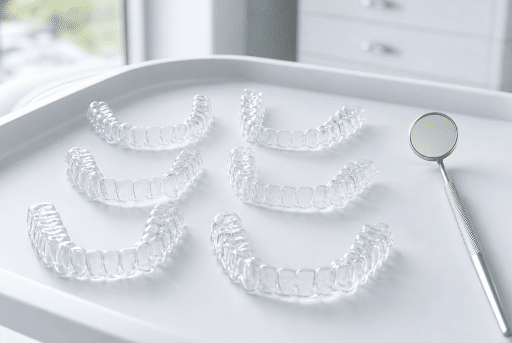
You’ve started looking into braces for your child, and clear aligners kept coming up. Now you want a straight answer: how long does a clear aligner treatment timeline actually run, month by month, and what happens at each stage. In short, most clear aligner treatment in Singapore runs from around 6 months for mild cases to 18-24 months for more complex bites, with progress checked roughly every 6 to 10 weeks.
The exact clear aligner treatment timeline your child follows depends on bite complexity, age, and how consistently the aligners are worn. This guide walks through what decides that timeline and what each phase looks like month by month.
Key Takeaways
- A typical clear aligner treatment timeline runs from about 6 months (mild crowding) to 18-24 months (complex bite correction), with growing children sometimes needing longer if jaw development is involved.
- Aligners generally need 20-22 hours of daily wear; inconsistent wear is the single biggest reason a timeline stretches beyond the original estimate.
- An initial specialist consultation in Singapore usually takes 15 to 30 minutes and costs $80 before GST, it is not a free assessment.
- Review visits are spaced further apart than with traditional braces, usually every 6 to 10 weeks, which suits busy school and family schedules.
- Retainer wear after treatment is not optional; skipping it risks relapse of the very movement the aligners achieved.
What Actually Decides Your Child's Aligner Timeline
Parents often assume aligner treatment duration in Singapore is fixed, like a school term. It isn’t. Three things drive the number of months your child will spend in aligners: how crowded or misaligned the teeth are, whether jaw growth needs guiding as well, and how reliably the aligners get worn.
Mild spacing or slight crowding in a child whose adult teeth have mostly come through tends to move faster than a case involving a developing crossbite, an overbite that needs jaw guidance, or several rotated teeth. Younger children in mixed dentition (a mix of baby and adult teeth) may be candidates for interceptive treatment, which is not the same as full aligner correction and often aims to guide growth rather than finish alignment in one go.
Aligners only move teeth when they’re actually on the teeth. Most orthodontists recommend 20 to 22 hours of daily wear, removing them only for meals, drinks other than water, and brushing. A teenager who takes them out for school lunches, sports, and forgets them overnight will see their treatment stretch well past the original estimate. This is the most common reason a projected 12-month plan becomes 16 months, a pattern that shows up consistently in clinical reviews of aligner compliance and treatment duration.
Treatment Complexity at a Glance
Case type | Typical timeline | What’s usually involved | Review frequency |
Mild crowding or spacing | Around 6 months | Fewer aligner stages, minimal attachments | Every 8-10 weeks |
Moderate crowding or rotation | Around 9-14 months | More aligner sets, some attachments for grip | Every 6-8 weeks |
Complex bite correction (overbite, crossbite) | Around 15-24 months | Attachments, possible elastics, closer monitoring | Every 6 weeks |
Growth-related interceptive cases (children) | Varies, often multi-phase | May combine aligners with growth guidance, reassessed as teeth erupt | Set by orthodontist per growth stage |
Key insight: The biggest swing factor in any clear aligner treatment timeline isn’t the aligner brand, it’s whether your child actually wears them for the full 20-22 hours a day, every day.
Month-by-Month: What the Journey Actually Looks Like
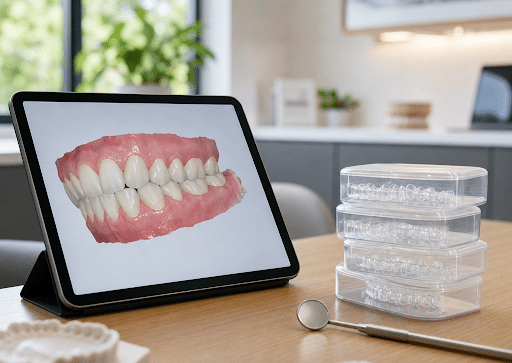
Breaking the aligner treatment stages into rough phases helps parents picture what’s coming, rather than just hearing “a year or so.”
Before Month 1: Assessment and planning.
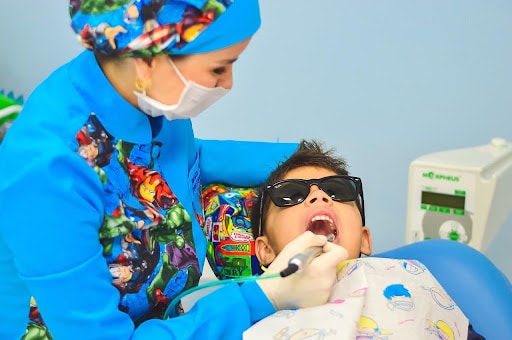
Before any aligner touches your child’s teeth, there’s a consultation. The orthodontist examines the bite, takes scans or photographs, and works out whether clear aligners are even the right tool. In Singapore, this initial visit with a specialist typically takes 15 to 30 minutes and costs $80 before GST, in keeping with national guidance on dental and orthodontic care standards.
It is not a complimentary session. If your child’s case turns out to be better suited to traditional braces or a staged interceptive approach, this is where you’ll find out before committing to a plan.
Months 1-2: First aligners and adjustment.
Once the plan is approved and aligners are fabricated, your child starts wearing the first set. Expect some pressure or mild soreness for the first few days of each new aligner — simply the sensation of teeth being nudged into position. Speech might sound slightly different for a day or two. Visible change is usually minimal this early; the movement is happening, it’s just too small to see yet.
Months 3-6: Visible movement begins.
Most mild-to-moderate cases start showing noticeable change here. Aligner sets are typically switched every 7 to 14 days depending on what the orthodontist has planned. Review appointments in this window check that each new aligner is tracking, meaning it seats fully and the teeth are moving as predicted.
If it isn’t tracking well, the orthodontist may pause, add an attachment (a small tooth-coloured bump that gives the aligner extra grip), or reissue a set. These reviews are built around catching tracking issues early.
Months 6-12: Mid-to-late treatment.
For moderate cases, this is often the final stretch. For more complex bite corrections, it’s the middle of the journey, where the bigger structural movements — closing gaps, correcting rotations, adjusting overbite — are underway.
This is also where compliance gaps show up clearest: a teenager who’s been inconsistent will often need extra “catch-up” aligners here, adding weeks or months to the original plan.
Months 12-24: Complex cases and refinement.
For children needing more substantial bite correction, treatment can run into the second year. Towards the end, many plans include a refinement phase, a short series of additional aligners to fine-tune the final position before the case is signed off. This isn’t a sign something went wrong; it’s a normal part of getting a precise result rather than a rushed one.
After treatment: Retention.
Once the active aligner stages finish, retainers take over, holding the teeth in their new position while the surrounding bone stabilises. Skipping retainer wear, or wearing it inconsistently, is one of the most common reasons teeth drift back towards their original position after all that time in aligners. Ask your orthodontist what this stage involves and how long retainers are typically needed in your child’s case.
Reading the Signs: When the Timeline Needs a Second Look
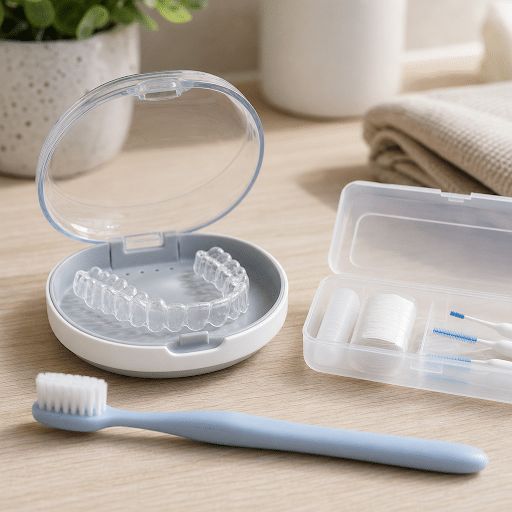
Most clear aligner treatment stages proceed quietly, aligner after aligner, with only mild discomfort. But there are moments that genuinely call for contacting the orthodontist rather than waiting for the next scheduled review.
- A new aligner won’t seat properly, even after a few days of wear. Forcing it can injure the gums.
- Pain or soreness that doesn’t ease off after the usual few days of adjustment.
- An attachment comes loose or falls off. These small bumps are doing real work; a missing one can stall movement.
- Unexpected bite changes, such as teeth no longer meeting the way they did at the last review.
- Gum bleeding, swelling, or redness that appears suddenly rather than from normal brushing.
- A cracked, lost, or ill-fitting aligner. Continuing to wear a damaged aligner, or trying to reshape one at home with heat or tools, isn’t safe. The safe step is always to contact the clinic and use the previous well-fitting aligner in the meantime if advised to.
None of these are reasons to panic, but they are reasons to call before the next scheduled appointment rather than after.
What a Review Appointment Actually Involves
A typical review is shorter than the first consultation. The orthodontist checks that the current aligner is tracking correctly, looks at gum health around any attachments, and confirms the bite is progressing as planned. If everything is on schedule, you’re handed the next few sets of aligners and given a date for the following review, usually 6 to 10 weeks out.
If tracking has slipped, expect a conversation about wear time, a possible mid-course adjustment, or occasionally a new scan to reissue aligners that better match where the teeth currently sit, an approach broadly consistent with general orthodontic guidance on monitoring teeth-straightening progress.
Aligners or Traditional Braces?
Consideration | Clear aligners | Traditional braces |
Best suited for | Mild to moderately complex cases, cooperative wearers | Complex cases, younger children who may remove aligners |
Daily responsibility | High, removable, so relies on consistent wear | Lower, fixed to the teeth, no daily decision needed |
Visibility | Discreet, largely unnoticeable | More visible, though ceramic options exist |
Review frequency | Roughly every 6-10 weeks | Often more frequent adjustments |
Typical suitability for growing children | Good for older children/teens with sufficient discipline | Often preferred for younger children or complex growth cases |
Frequently Asked Questions
Teenagers often move through treatment at a similar pace to adults for comparable cases, since the deciding factor is usually bite complexity and wear compliance rather than age alone. Younger patients still going through jaw growth may follow a different, staged approach that isn’t a straightforward comparison to adult timelines.
Inconsistent wear is the most common cause of a stretched-out timeline. If aligners aren’t worn for close to the recommended 20-22 hours daily, teeth move slower than planned, and the next set may not fit properly. The orthodontist may need to reissue aligners or extend the plan, so it’s worth flagging compliance struggles early rather than letting it drift for months.
Some clinics offer more frequent aligner changes for suitable cases, but this depends entirely on how well the teeth are responding and isn’t appropriate for every bite type. It’s a decision for the orthodontist to make case by case, not something to request purely for convenience.
Most orthodontists use digital scans or imaging as part of the initial assessment to map out tooth positions and plan the aligner stages accurately. This is typically covered within the consultation process rather than being a separate, unexplained cost.
Getting Your Child Started
If you’re weighing up whether clear aligners suit your child’s bite and lifestyle, the next useful step is a proper assessment rather than more searching. A specialist consultation will map your child’s bite against a realistic clear aligner treatment timeline, so book one when you’re ready to move from researching to planning.